14 Predator-Proof Chicken Run Ideas
Every chicken keeper eventually meets the night something tested the run. The difference between a sad story and a non-event is almost never luck — it is a handful of unglamorous details done properly: the right mesh, a skirt of wire on the ground, a latch that needs thumbs. These fourteen predator-proofing ideas are the upgrades that matter, in roughly the order to do them. They all expand on our main predator-proof chicken run guide, which has the full checklist, the mesh specifications and the reasoning — read that first if you are starting from zero, then use this list to work through your own run.

A word about honesty before the list: no run is predator-proof in the absolute sense, and any product or plan that promises that is selling something. What these ideas do is close the specific doors that real predators actually use — digging under, reaching through, climbing over, flipping latches, and walking in through the gap you meant to fix. A determined bear defeats almost any backyard build; a raccoon, fox, dog, hawk or mink — the predators that take nearly all backyard hens — can be stopped cold by the details below.
Work through them with your own worst visitor in mind. The keeper with hawks needs the roof first; the keeper with foxes needs the apron; everyone needs the mesh and the latch. Costs are for a typical 8′ × 16′ garden run unless the idea is priced per item.
1. Hardware Cloth on Every Face
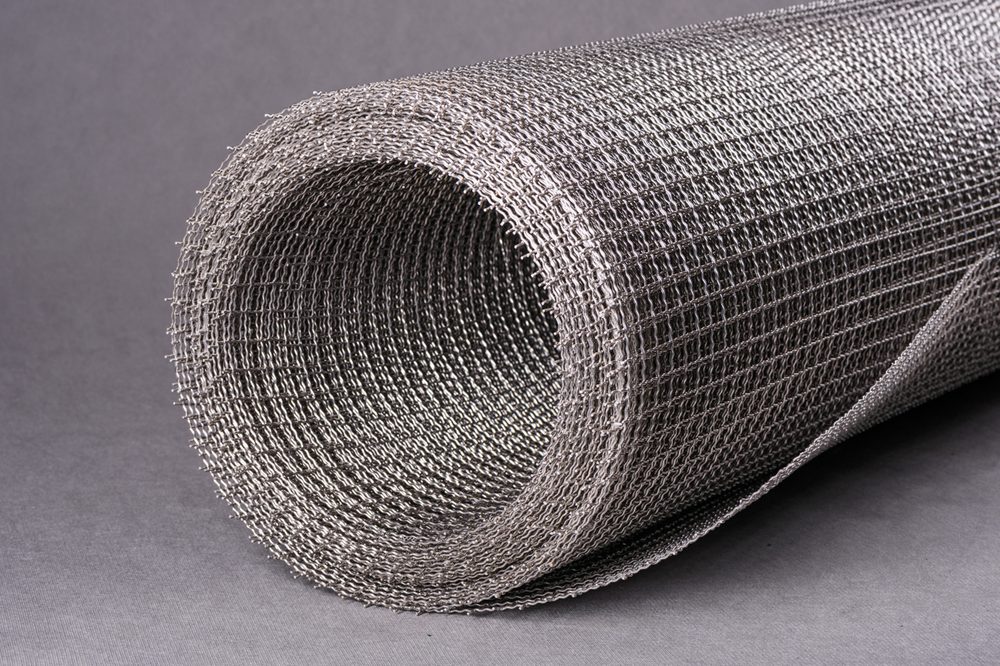
The single most important upgrade in chicken keeping: replace or line every mesh surface with ½-inch, 19-gauge galvanised hardware cloth. Its welded grid is too small for a raccoon's arm, too strong for a dog's lunge, and too rigid to tear like woven wire. Raccoons kill through mesh they cannot enter — a hen sleeping against wide-gauge wire can be grabbed through it — and hardware cloth ends that completely.
Fit it with screws and washers, not staples, which pull out under a determined pull. Overlap seams by an inch and wire or screw them together; a seam gap is a door. Yes, it costs more than chicken wire — roughly double per roll — and it is still the cheapest insurance on this page, because it only has to work once to have paid for itself. The full specification, including where ¼-inch mesh earns its extra cost, is in the main guide.
2. The Ground Apron (Skirt)
Digging predators dig at the base of the wall — and stop when they hit wire. An apron exploits that: a strip of hardware cloth or welded mesh laid flat on the ground, running 12 to 18 inches out from the run wall, pinned down and covered with a skim of soil or gravel. The fox digs at the fence line, meets mesh, and gives up; it never thinks to back up two feet and start again.
An apron beats burying mesh vertically, because buried wire rusts unseen and a digger who gets under it is inside. The apron stays inspectable, can be added to an existing run in an afternoon, and works on ground too rocky or rooty to trench. Pin it every foot or so with landscape staples, weight the outer edge with stones or soil, and let the grass grow through — within a season it disappears, still working.
3. Buried Mesh Footer Where Aprons Can't Go
Where an apron cannot lie flat — against a building, along a path, on a slope you mow — the fallback is a buried footer: mesh run 12 inches down in a narrow trench at the wall base, ideally with the bottom 4 inches bent outward in an L. It is more work than an apron and less forgiving, but on the edges where aprons fail it is the right tool.
Two details decide whether a footer works. First, the bend: a straight vertical sheet invites a digger to follow it down and under; the outward L at the bottom turns the dig aside, apron-style. Second, the join: the buried mesh must overlap and fasten to the wall mesh with no gap at ground level, because ground level is exactly where the digging starts. Galvanised mesh in soil lasts years, not decades — note the date you buried it and inspect the join each spring.
4. Two-Step Latches on Every Door
Raccoons open simple latches. They flip hasps, lift slide bolts and work hooks out of eyes with the patience of tiny burglars, because that is essentially what they are. The fix costs almost nothing: any latch that needs two different actions — a slide bolt plus a spring clip, a hasp plus a carabiner through its loop, a barrel bolt with a locking pin. If a toddler could not open it quickly, a raccoon almost certainly cannot either.
Audit every opening, not just the people door: nest-box lids, clean-out hatches, feed-bin lids and pop doors all count, and the one you forget is the one that gets used. Fit latches at a height and angle that stays easy for cold human fingers in January — a latch you hate using is a latch that gets left undone, which is worse than a simple one that always gets closed. Fit the same latch to the egg-box lid and the feed store while you are at it; raccoons shop the whole premises, not just the run door.
5. A Roof — Solid or Mesh — Over the Whole Run
An open-topped run is an invitation to everything that flies or climbs: hawks and owls drop in, raccoons and opossums go over the wall, and in some areas fishers and martens treat fences as ladders. A full cover closes the whole category. Mesh is the minimum; solid panels over part of the run add the dry ground that keeps a run pleasant, and the two combine well — mesh everywhere, panels over the third nearest the coop.
Netting alone is the budget option and the weakest: determined raccoons chew and tear light netting, and snow loads collapse it. If you start with netting, treat it as a hawk deterrent only and upgrade the climbing routes — corners and posts — with hardware cloth bands. A framed mesh roof costs more and ends the argument; on a permanent run it is worth doing once, properly, with the slope to shed water and the fixings to survive a raccoon walking on it.
6. A Framed, Full-Height Door That Seals
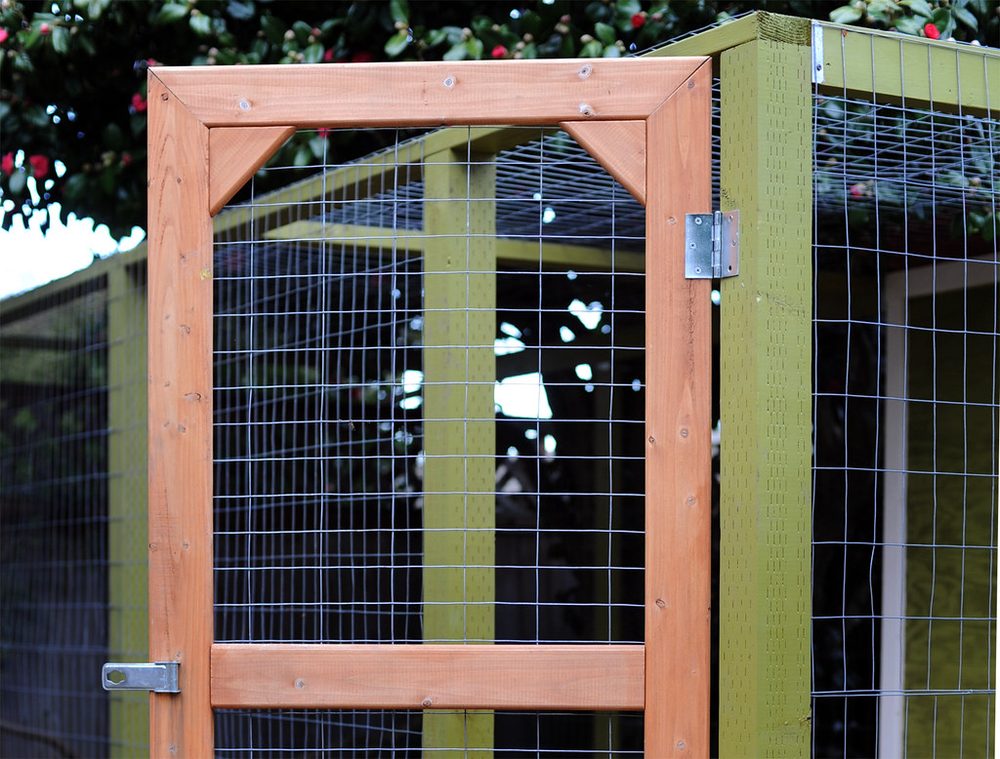
The door is the hole you cut in your own defences, and on many runs it is the weakest part: a sagging frame, a thumb-sized gap at the bottom, a latch that needs a lift-and-jiggle a raccoon will eventually manage. A properly framed door — rigid, hung on two or three real hinges, closing against a stop on all four sides with gaps under ½ inch — restores the wall it interrupts.
Build the frame with a diagonal brace so it cannot sag into a diamond, and fit a threshold or a mesh flap at the bottom where doors always gap first. Self-closing hinges are worth their small cost on a run you enter with your hands full of feed buckets. Then give it idea #4's two-step latch. It sounds like a lot of fuss for a door; it is the fuss that the whole rest of the run depends on.
7. Retire the Chicken Wire
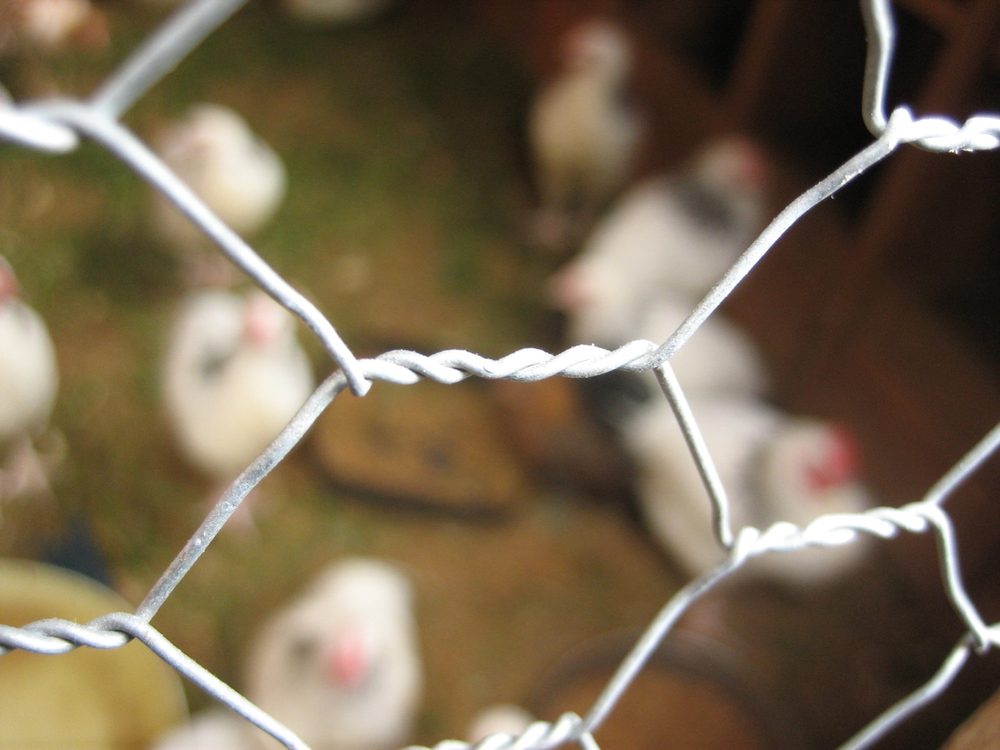
Chicken wire has one job — keeping chickens in — and it does only that. Its thin twisted strands tear under a dog's lunge, unravel when snipped, and its hexagonal holes pass a raccoon's arm with room to spare. If your run is skinned in it, you do not have to rebuild: line the inside with hardware cloth, keeping the old wire as a harmless outer layer, and the run is transformed in a weekend.
Prioritise if money is tight: the lower 3 feet of every wall first (the reaching and lunging zone), then the door, then the top and roof. And stop buying it for new projects — welded mesh and hardware cloth cost little more per project at backyard scale, last far longer, and do not need a warning label. The kindest thing to say about chicken wire is that it makes good garden cloches; use it there instead.
8. An Electric Strand at Nose Height
One or two strands of electric wire on insulators, run around the outside of the run at 6 and 12 inches, change the predator's whole calculation: the fence itself bites. Foxes test fences with their noses, dogs with their chests, raccoons with their hands — one zap teaches a lesson that lasts the season, and it works on the nights you forget nothing but the predator remembers everything.
Electric is a supplement, not a substitute: it fails when the battery dies, the line shorts on wet vegetation, or snow buries the low strand, so the mesh and apron underneath still have to be honest. Keep the line clear, test it weekly with a fence tester, and signpost it if neighbours or kids pass by. For whole paddocks rather than a garden run, electric netting (idea #7 in our large-flock run ideas) is the same principle scaled up. Signage is a kindness as much as a warning — a small "electric fence" tag saves the neighbour's dog and your conscience the same afternoon.
9. Paver or Grid Edging at the Gate and Door Zone
The ground at the gate is where aprons get kicked aside, mesh gets exposed and digging starts — because it is also where you walk, spill feed and wear the surface away. A row of paving slabs, concrete blocks or ground-reinforcement grids bedded along the gate and door line armours exactly that strip: nothing digs through a paver, and the apron beneath stays buried and working.
It doubles as mud control, which is why it earns its place even in low-predator areas — the flooring guide recommends the same treatment for gateways. Bed slabs on a levelled sand base, tight together, with the mesh apron running underneath and out the other side. Hens lose nothing: they will dust bathe somewhere else, and you gain a clean, dry threshold to stand on in February. If slabs are scarce, start with the pop-door landing and the gate only — those two patches take most of the wear — and add the rest as second-hand slabs turn up, which they reliably do.
10. An Automatic Coop Door, Checked Weekly
Most flock losses happen at dusk, in the gap between the hens going to roost and a human remembering to close the pop door. A light-sensing or timer automatic door closes that gap every single evening, including the evenings you are away, ill or simply late. For keepers who work past dark in winter, it is the single highest-value gadget in the hobby.
Buy for reliability, not features: a door that runs on batteries with a manual override, a track that cannot jam on a stray piece of bedding, and a closing action slow and light enough not to trap a dawdling hen. Then check it weekly — auto doors fail quietly, batteries fade, and litter builds up in tracks. The door buys you consistency; the weekly glance keeps the consistency real. It protects the coop, note, not the run: the flock still needs the run itself secured for daytime.
11. Motion-Activated Light at the Run
A solar motion light over the run door will not stop a determined predator, and this list will not pretend otherwise — foxes in lit farmyards exist. What it does is startle the cautious ones, alert you when something is moving out there at 2 a.m., and light your own path on the nights you go out to check a noise. As a supplement to real barriers, it earns its twenty dollars.
Mount it high, aimed down the approach side rather than into the run — a light that fires into the coop disturbs the hens' sleep every time a moth passes. Solar models with replaceable batteries last longest. Think of the light as an alarm and a torch, not a fence: if a light is the only thing between a predator and your flock, the flock is not protected, it is illuminated. Tell your neighbours the light exists before the first 2 a.m. fox sets it strobing; a warned neighbour is an ally, not a complainant.
12. Seal the Gaps: Corners, Eaves and Junctions
The small predators do not attack the wall; they use the building's mistakes. A mink needs a gap of about an inch, a weasel less, a rat less still — and those gaps live where mesh meets roof, where the run joins the coop, at corners where two mesh runs were stapled a half-inch apart, and under doors. A slow walk around your own run, at hen height, with a ½-inch stick as a gauge, finds them all.
Pack or cover every gap the gauge passes through: mesh offcuts screwed over junctions, backer rod and hardware cloth at eaves, a threshold strip under the pop door. Where the coop meets the run is the classic miss — hens pass through a pop door, and so can anything smaller than a hen unless the surround is meshed tight. This is the cheapest idea on the page and the one that saves flocks from the predators nobody saw coming.
13. Store Feed Like It Matters (It Does)

Spilled feed and an open feed sack are a dinner invitation that brings raccoons, rats and opossums to your run nightly — and a predator that visits every night will eventually test the defences properly. Feed belongs in a metal bin with a tight, weighted or latched lid, stored outside the run or in a sealed section of the coop. Plastic bins are chewable; sacks are an open buffet.
Pair storage with tidy feeding: feeders the hens cannot scratch empty onto the ground, quantities eaten by roost time, and no treats scattered at dusk. The goal is a run that smells like chickens, not like a restaurant. It is unglamorous, entirely within your control, and it lowers the pressure on every other idea on this list — the best predator-proofing is the predator that never gets interested in the first place. The same discipline covers fallen fruit and kitchen scraps tipped near the fence — generosity at dusk is an invitation written in calories.
14. The Nightly Lock-Up and Weekly Walk-Around

Every physical upgrade on this list is maintained or defeated by a habit. The habit has two parts: a nightly lock-up — pop door closed, latches done, a glance at the apron line — and a weekly walk-around with fresh eyes, checking for new diggings, rust at the mesh base, sagging doors, chewed corners and the first exploratory scrape of something testing you.
Predators announce themselves before they succeed: a shallow dig at one corner, droppings on the path, a hen flock suddenly reluctant to enter one end of the run. The weekly walk is when you catch the announcement and answer it — an extra apron section here, a repaired seam there — while it is still cheap. Keepers who do this lose very few birds, and it is not because their runs are fortresses. It is because their runs are inspected, which is a different and much more achievable thing.
How to use this list on your own run
Walk the list in order against your run and mark what is missing — most keepers find three or four gaps, not fourteen. Fix them in this priority: mesh (#1) and latches (#4) first, because they guard every hour of every day; the apron (#2) and roof (#5) next, because they close whole categories of attack; then the detail work — gaps (#12), door (#6), feed (#13) — and the habits (#14) that keep it all true. The full reasoning, mesh gauges and measurements are in the predator-proofing guide.
Scale the spend to the threat. A suburban run whose worst visitor is a neighbour's cat needs less than a rural run on a fox path — but raccoons live nearly everywhere chickens do, and they are the benchmark predator for backyard builds. If you are planning a new run rather than fixing one, the free 8′ × 16′ plan already includes the apron, mesh spec and latch choices from this list, and our large-flock ideas show how the same principles stretch to paddocks and barns.
FAQs
Is hardware cloth really necessary, or is welded wire enough?
Welded wire with small openings (1″ × ½″ or 2″ × 2″ in heavy gauge) stops dogs and foxes pushing through, but raccoons reach through anything wider than about ½ inch and kill hens at the wire. Hardware cloth at ½ inch is the standard because it answers the reach-through problem as well as the push-through one. If budget forces a mix, hardware cloth on the lower walls and coop surround, welded wire up high.
How wide should a predator apron be?
Twelve inches is the minimum that works; 18 inches is better, and 24 inches on the side facing open ground or a known fox path is cheap peace of mind. Pin it flat, cover it lightly, and make sure it joins the wall mesh with no gap at the base — the join, not the width, is where aprons fail.
Can raccoons really open latches?
Yes — simple hooks, flip hasps and loose slide bolts are all documented raccoon-openers, and they learn. Any fastening that needs two different motions, or a clip through a loop, defeats them. Test yours honestly: if you can open it with one hand, quickly, without looking, assume a raccoon can too.
Do I need to lock hens in the coop at night, or is a secure run enough?
A genuinely sealed run — hardware cloth everywhere, apron, roof, two-step latches — can be enough, and many keepers rely on one. But the coop door closed at night is a second wall, and second walls are what save flocks when the first one has a flaw nobody noticed. Belt and braces: secure run, closed pop door, every night.
What about hawks — will a scarecrow or owl decoy work?
Decoys work for days, until the local hawks learn they never move; moving them helps briefly. What works permanently is cover: a mesh or solid roof, or dense overhead lines and shelter the hens can dive under. If hawks are your main pressure, idea #5 is your first spend, ahead of everything except mesh.
Ready to build one properly?
Our free starter plan — the Backyard Run, 8′ × 16′ — is drawn predator-tight from the start: hardware cloth spec, ground apron, two-step latches and a framed door, with the full materials list to build it.
Pin it for later