13 Chicken Tractor Ideas: Mobile Runs That Mow Your Lawn
A chicken tractor is a floorless, movable run that turns your flock into a lawn service: fresh grass every day, bugs eaten, fertiliser spread, no patch scratched to mud. The catch is in the word movable — a tractor only works if it is light enough that you actually move it. These 13 designs run from a two-hen garden ark to a trailer coop for pasture flocks, each with a spec card, an honest 2026 cost estimate and the moving method spelled out, because that is the detail that decides everything.
Two ground rules. First, weight is destiny: as a working limit, a tractor one person moves daily should stay under roughly what you can lift at one end without thinking — if moving it feels like a chore, it will happen weekly, then monthly, then never. Second, a floorless pen is not automatically a safe pen. On slabs or with a mesh skirt it can be; on open ground in fox country it needs the same thinking as any run in our predator-proofing guide. Sizing still follows the 10 square feet per bird rule — tractors get a little grace because the ground is always fresh, but not much.
The 13 chicken tractor ideas
1. Classic A-Frame Tractor on Wheels
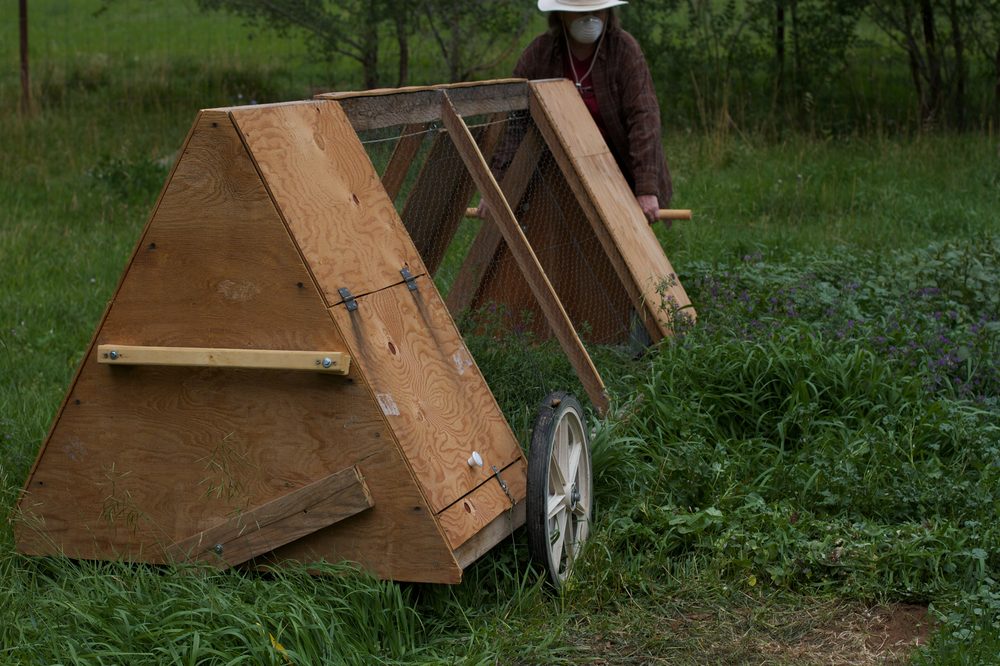
The design that started the tractor idea for most keepers: a triangular frame, mesh on both slopes, a sheltered roosting section at one end, wheels at the back and lift handles at the front. You raise the front, roll it one length forward, and the flock has new ground. Build it from 2×2 or 2×3 stock rather than 2×4 wherever you can — every pound saved is a move that actually happens. Fit the wheels on a simple axle that lifts the frame clear only when you raise the handles, so the skirt sits flush on the ground the rest of the time and nothing squeezes under. A daily move of one tractor-length is the rhythm that keeps grass alive.
2. Ark-Style Tractor With an End Coop
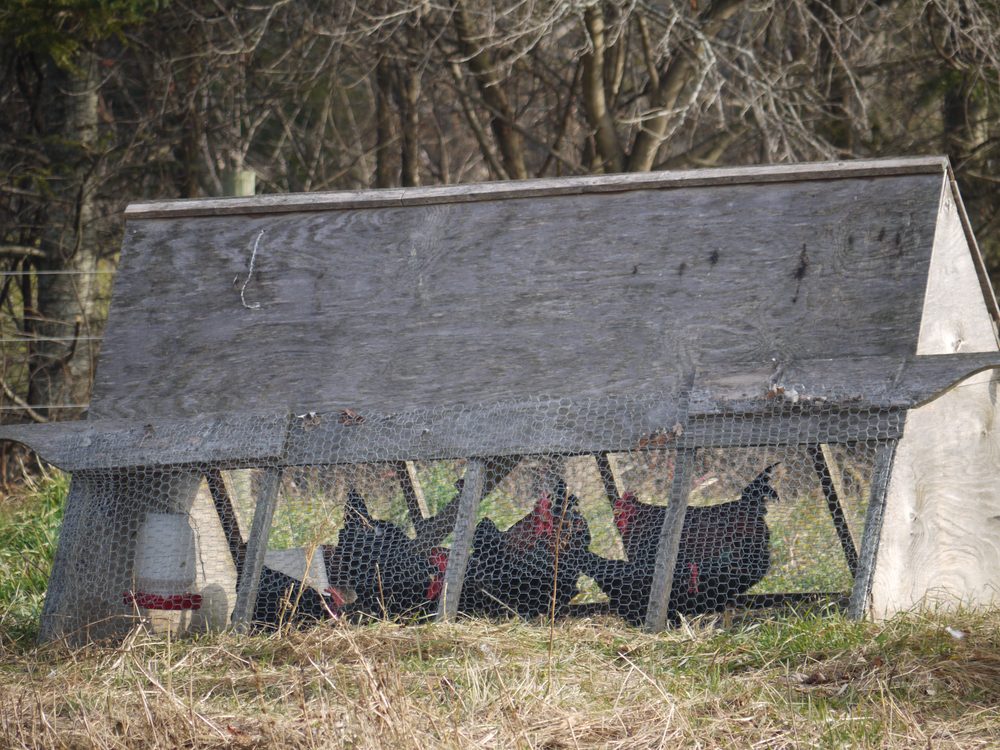
The ark puts a solid coop box at the raised end of a low A-frame run, so shelter, roost and run travel together. Hens climb a ramp to roost above the run, which keeps the sleeping space dry and gives the run full use of the footprint. Arks suit small gardens because they are tidy and self-contained — the whole flock's home in one draggable unit. The design's weakness is access: cleaning the coop end through a small door, on your knees, is the job everyone underestimates. Build the biggest access door the end panel allows, and a removable roost bar, and the ark stays charming instead of becoming a chore.
3. Salatin-Style Pasture Pen
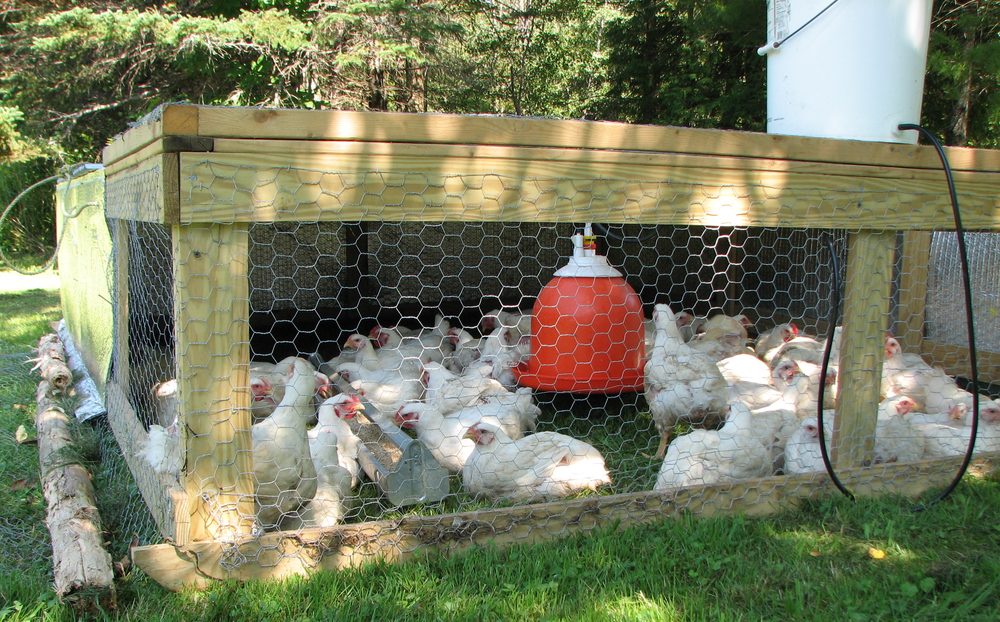
The low, flat-topped floorless pen made famous by pasture poultry farms: a light box frame, mesh sides, a part-solid roof, dragged one length daily with a dolly under the front edge. It is not pretty and it is not meant to be — it is a production tool that grows birds on grass with minimal labour per bird. For layers, add a roost bar and nest boxes on a rear rail. The pen's low profile is its weather strategy (wind passes over) and its limitation (you service it from outside, bending). On rough or sloping pasture the drag gets heavy fast; this design belongs on reasonably level ground, moved religiously, because 25 birds on one patch for three days is a manure problem, not a fertiliser plan.
4. Hoop Tractor on Skids
Bend PVC or electrical conduit hoops over a rectangular skid base and you get standing headroom in the middle for a fraction of a framed tractor's weight. It drags rather than rolls, which suits soft ground where small wheels dig in. The hoops flex, so brace the ends with diagonal struts and a ridge line, or the whole thing racks into a parallelogram by August. Our PVC run guide covers the pipe version's UV and strength limits in detail. A hoop tractor is a fair-weather, low-predator-pressure tool — brilliant for rotating hens through garden beds after harvest, wrong as the only housing where dogs roam.
5. Wheeled Coop With an Integrated Run
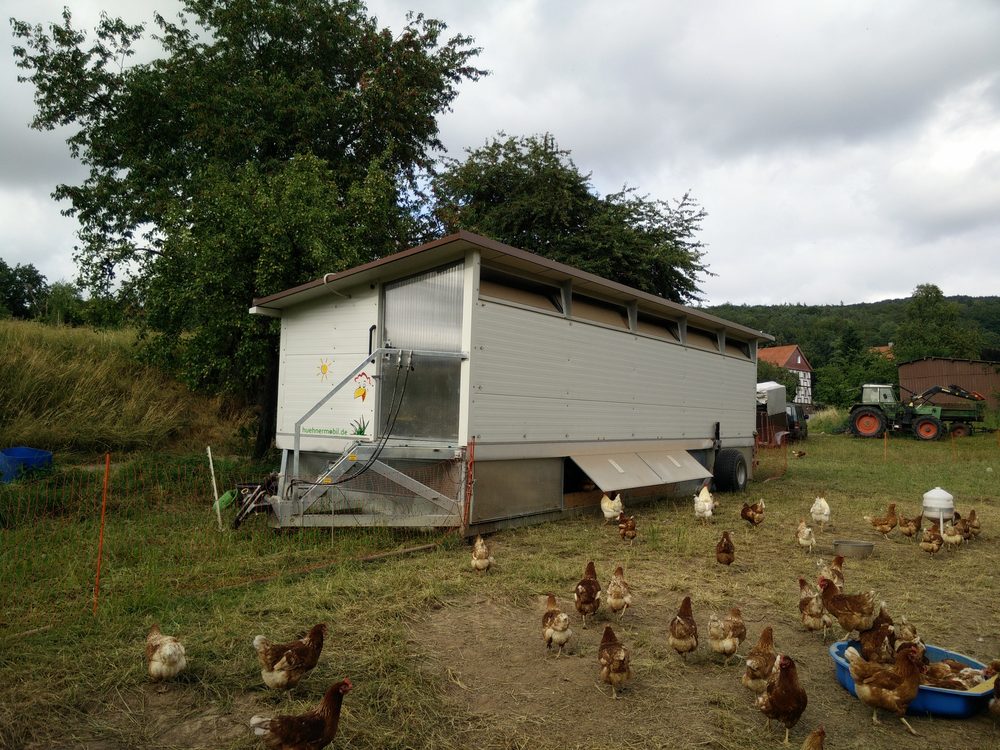
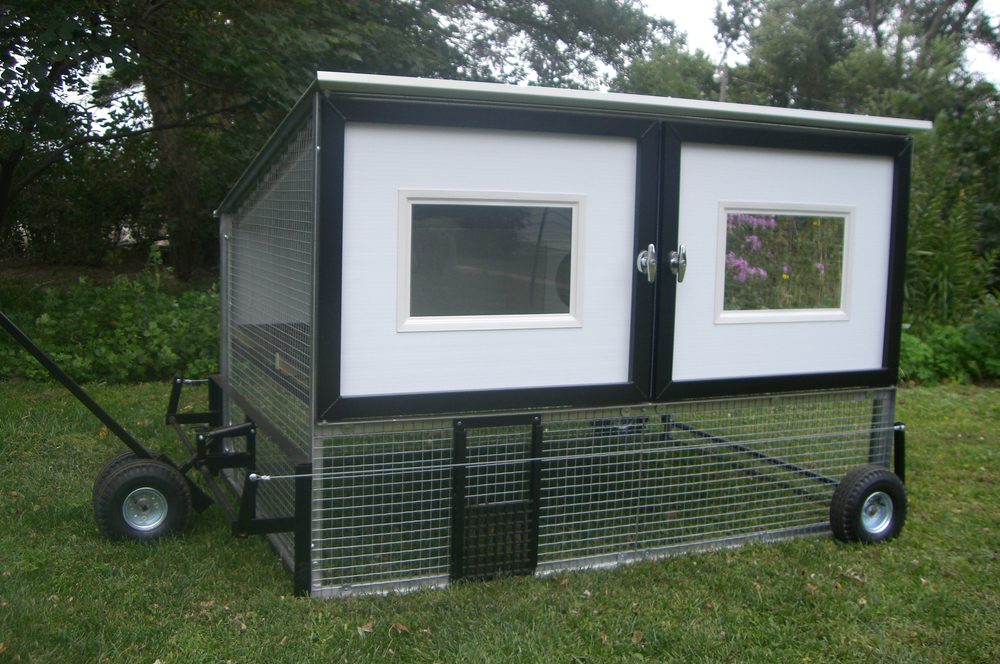
Step up from dragging to rolling: a coop body on a proper axle with bicycle or wheelbarrow wheels, towing handle, and a mesh run that folds or fixes around it. Moving becomes a two-minute job you can do in work clothes, which means it happens. The engineering that matters is the axle placement — balance the coop so the handle carries a little weight, not half the building — and wheels big enough for your ground; small castors are lawn ornaments on real grass. These make excellent permanent homes for small flocks on rented land, because the whole setup can be towed onto a trailer when you move.
6. Trailer-Based Mobile Coop for Pasture Flocks
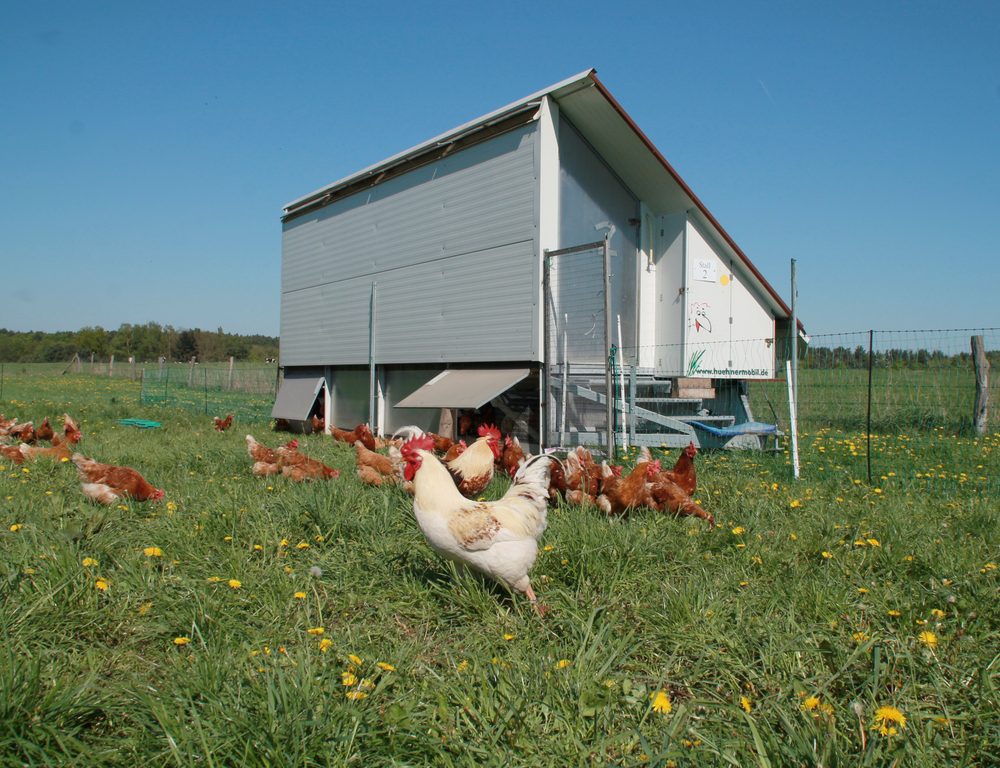
At flock scale the tractor becomes a vehicle: a coop built on a trailer chassis or farm wagon, towed by tractor or truck to a fresh paddock every few days, with the hens ranging around it. Egg collection, feeding and watering all happen at the coop, and a movable electric fence (idea 8) defines the paddock. This is how pasture egg operations actually run, and the per-hen housing cost is low — but it is a farm tool, not a garden one: it needs a tow vehicle, turning room and ground that takes wheels in winter. If your flock is heading this way, our extension ideas cover the fencing half of the system.
7. Lightweight Garden Ark for Lawns
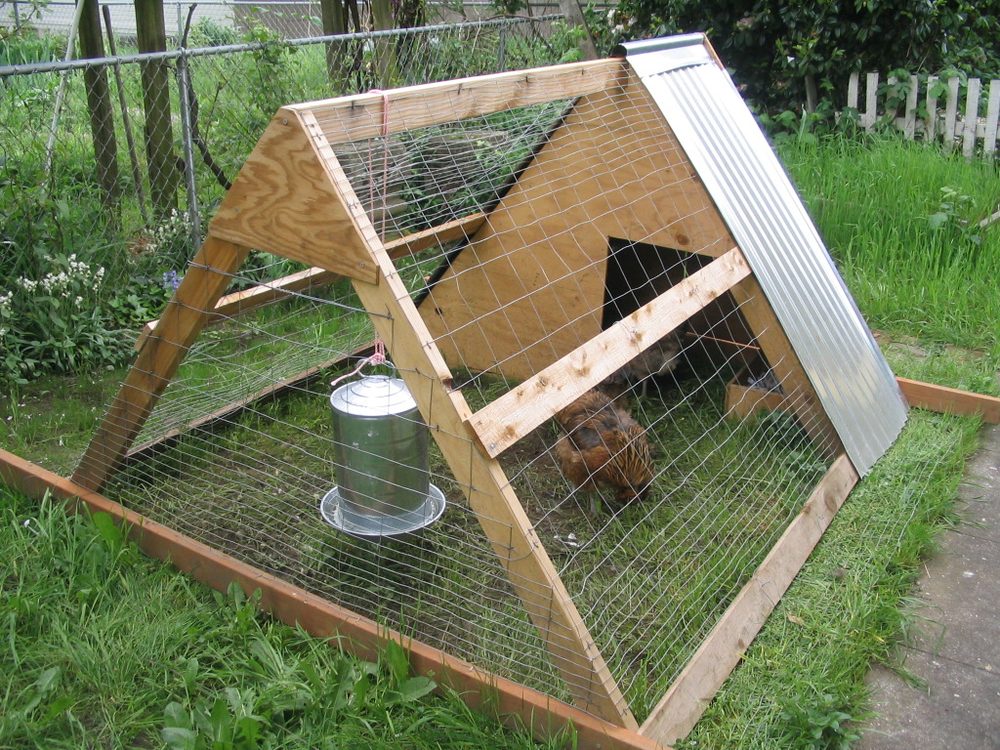
A scaled-down ark built for looks as much as function: clean timber, a corrugated or shingled cap on the coop end, and proportions that sit happily on a suburban lawn. The discipline is the same as the big A-frame — move it a length a day — but at this size one person can carry-drag it in slippers. Garden arks earn their keep as lawn rehabilitation: park one on a weedy, thin patch for a week and the hens will clear, scratch and fertilise it ready for reseeding. Rotate systematically across the lawn rather than wherever looks worst, or you will end up with one immaculate corner and a flock that has favourites.
8. Tractor Plus Electric Netting Paddock
Park the tractor as the flock's bedroom inside a movable electric poultry-netting fence, and you combine a secure night base with a big rotating day range. The netting moves in twenty minutes, the tractor weekly, and the hens get far more ground than any pen alone provides. This is the system most pasture keepers settle on after trying everything else. Two honest costs: the energiser and netting are a real purchase (solar energisers suit remote paddocks), and netting is a deterrent, not a wall — it works because predators touch it once. In high-pressure areas the flock still needs locking into the tractor at night, every night.
9. Two-Person Carry Tractor
Where steps, narrow gates or terraces defeat wheels, the answer is a tractor built to be carried: rigid frame, four proper handles, and a strict weight budget. Two people lift it a length forward in seconds, and it goes places no wheeled design can — up a garden step, across a bed, through a side gate. The design constraint is brutal honesty about weight: every feature is judged in pounds. Skip the solid roof (use a tarp panel), use mesh instead of boards, and keep the shelter to a small box at one end. If it creeps over what two people lift comfortably, it becomes a stationary run with handles as decoration.
10. Skid Tractor for Soft Ground
Wheels sink; skids float. A tractor built on two stout timber skids, towed by a rope, mower or quad, spreads its weight and moves over soft ground that would bog an axle to the hubs. Round the front ends of the skids up like a sled so it rides over tussocks instead of ploughing them. The trade-off is friction: a skid tractor needs a genuinely strong pull on anything but short grass, and turning means dragging the back end around in an arc. On firm lawns this is the wrong tool (see idea 1); on a wet acre it is the only one that works in February.
11. Tall Walk-In Tractor
The luxury build: a full-height framed run on a wheeled chassis, moved with a tow bar. You keep every walk-in benefit — upright cleaning, hanging feeders, easy catching — and still rotate ground. It is also the easiest tractor to build badly: tall, light structures rack and twist when towed over bumps, so the frame needs diagonal bracing on every face and wheels placed to carry the load without flexing the walls. Move it slowly, on the flattest route, with the hens shut in the coop end. If your ground is rough or steep, read the walk-in ideas and build stationary instead — this design's one true enemy is a hillside.
12. Mini Tractor for Growers and Bantams
A low, light pen for the in-between weeks: chicks old enough to want grass, too small and hawk-tasty for the open range. A mini tractor gives them fresh ground and bugs daily while keeping them under mesh, and it parks against the main run so the adult flock can watch the youngsters they'll soon live with — integration starts here. Keep the height low (a foot or so is plenty for growers) and the mesh fine; young birds squeeze through gaps that adults cannot. When the growers move up, the same pen becomes a bantam run, a broody pen, or a hospital ward. Few tools earn their keep in as many roles.
13. Convertible Tractor That Parks for Winter
Design the tractor to change jobs with the seasons: wheels and handles for the growing season, then in late autumn it parks on a prepared base — slabs or deep gravel — the wheels come off or chock up, a roof panel bolts on, and it becomes a stationary winter run on deep litter. This solves the tractor's one structural weakness, which is that frozen or waterlogged ground cannot be rotated and a floorless pen on mud is miserable for everyone. Build the conversion in from the start: level parking spot chosen in spring, roof panel stored flat against the coop, skirt boards cut and labelled. Fifteen minutes in November, not a rebuild.
How to choose a chicken tractor
Choose by your ground and your flock size, in that order. Small lawns and small flocks: ideas 1, 2 and 7. Meat birds or layers on real pasture: ideas 3, 6 and 8. Soft or wet ground: skids (idea 10) or big wheels (idea 5). Awkward access: carry it (idea 9). Whatever you pick, run the weight test before you build — sketch the materials list and add it up; if the total makes you wince, redesign lighter, because the tractor you move daily at 60 pounds beats the palace that never moves at 200. Compare the stationary alternatives in 15 cheap chicken run ideas if your ground is steep, tiny or paved — tractors are not the answer to every yard.
The daily move: technique and ground management
Move like you mean it. Shift the tractor its full length each day, in a planned direction, rather than nudging it wherever looks green. Work the ground in strips, the way you would mow: along the field or lawn one way, back along the next strip. A planned pattern means no patch gets double-dosed with manure and no patch gets skipped, and at the end of the rotation you know exactly how many days of ground you have. Most backyard rotations give each patch three to six weeks of rest before the hens return — enough for grass to regrow and for the droppings to disappear into the soil.
Time the move to the hens. Move the tractor when the flock is settled — mid-morning works well — and move it slowly, walking the hens forward inside rather than dragging the pen over them. Hens learn the routine within days and stroll ahead of the moving wall; the ones that panic are usually telling you the pace is too fast or the shelter end has gone dark and scary. A handful of scratch grain scattered at the far end teaches the commute faster than any amount of herding.
Feed and water travel too. The practical detail that separates working tractors from abandoned ones: hang the waterer so it moves with the pen (a sloshing half-full waterer is heavy enough — fill after the move, not before), keep the feeder under the sheltered end so rain never reaches it, and carry the day's feed in a lidded bucket that lives at the tractor. Every separate trip back to the house is friction, and friction is what quietly kills daily-move systems by August.
Chicken tractor FAQs
How often should I move a chicken tractor?
Daily is the ideal — one tractor-length forward, so the flock always stands on fresh grass and droppings never build up. Every second day is acceptable for light stocking. If moves stretch to weekly, the ground under the tractor will be bare and the system is failing; lighten the tractor or reduce the flock in it.
Do chicken tractors protect hens at night?
Only if built and parked for it. A tractor on open ground can be dug under in minutes. Park it on slabs at night, fit a mesh floor or skirt, or shut the hens in a solid coop section. In high-predator areas, treat the tractor as a day run and the coop as the night defence.
Will a chicken tractor ruin my lawn?
Moved daily, it improves it — that is the point of the system: light grazing, scratching and fertilising, then rest. Left in one place for a week, the same hens will strip a patch to dirt. The tractor is not the variable; the moving schedule is.
What size wheels does a chicken tractor need?
Bigger than you think. On grass, 10–14 inch wheels roll over bumps and molehills that stop small castors dead. Wheels that lift the frame only while moving — dropping it flush at rest — are the best arrangement for both rolling and predator-proofing.
Can I keep layers in a tractor all year?
In mild climates, yes, with a solid coop section and a winter parking plan. In harsh winters, use a convertible design (idea 13) or move the flock to a stationary run for the worst months — a floorless pen on frozen mud serves nobody well.
How do I stop hens escaping while I move the tractor?
Move slowly and let the flock walk ahead of the moving wall — scatter a little scratch grain at the destination end and they will commute themselves. Hens escape during moves when the pen lifts too high or moves too fast; keep the lift to a couple of inches and the pace to a stroll, and stragglers become rare.
Can a chicken tractor work on a small suburban lawn?
Yes — it is arguably where tractors work best. A small ark or A-frame (ideas 1, 2 and 7) rotated daily across a suburban lawn gives a pair or trio of hens a constantly fresh run in a garden that could never fit a fixed run of the same effective size. The lawn benefits visibly within a season. The suburban caveats are storage (a tractor lives outside, in view), neighbourly hours for moving day, and night security, which matters more where urban foxes and raccoons patrol gardens.
Ready to build one properly?
Our free starter plan — the Backyard Run, 8′ × 16′ — is a stationary framed run, but its panel construction adapts well: build the walls as bolted panels and the same design can be re-sited or extended later.
Get the free starter plan See the lightest run of all: PVC →
Pin it for later